Imperial Infantry, Second Afghan War 1878-80 | ||||
I have been intrigued by an illustration entitled "Route Marching 2nd Battalion Queen's 1879 Peshawa, India". This shows British infantry in the transitional khaki tunic with home service blue trousers with red stripe and covered foreign service helmet. The 70th (Surrey) Regiment of Foot and the 2nd Battalion The Queen’s (Second) Royal, Regiment of Foot, were both in Afghanistan at this time and the illustration could be of either regiment, despite the title, and they were ultimately amalgamated.
 
With these illustrations in mind, I asked Carl Robson to swap the Perry Sudan War infantry head with covered helmet, with the Pontoonier Miniatures British Infantry body. This was from expert advise I received from Ethan "Mad Guru" Reiff to create the "definitive" British infantry from the Second Afghan War. Ethan encourage me to commission the 66th (Berkshire) Regiment of Foot of Maiwand fame. I wasn't sure how this experiment would turn out, so in deference to the memory of the 66th, I asked Carl to paint the Queen's instead. I am very pleased with the result. The swap enables the figure to carry the correct equipment for this war and to have an appropriate helmet.
The pouches were black leather, not the white shown below, but this gives an idea of how the equipment looked.
   
|
Sunday, December 23, 2012
Imperial Infantry, Second Afghan War 1878-80


Tuesday, November 27, 2012
the Alamo (2004)

I just finished watching the "The Alamo", the 2004 movie version of the epic siege of February 23 to March 6, 1836. This was entirely due to the patriotic fervor of my favourite Texan, 2nd Lt. Kris Floyd, USMC. After discussing the battle over Thanksgiving, I sought out and watched the movie. I am astonished I missed it and very glad to have made amends. This is an excellent dramatic and historical telling of the tale. Billy Bob Thornton in particular is excellent as David Crockett. His character and personal charm comes through loud and clear. This is the Crocket of "Three Roads to the Alamo" by William C Davis, an excellent book on the background of all the protagonists.

Strange to say, this was also sitting in my library unread and rediscovered for me by Kris Floyd. I'm correcting that mistake and am now deeply immersed in the book.
The scene in which David Crocket plays his fiddle from the Alamo battlements as Santa Ana's national Mexican Army plays military marches with great bombast is an excellent touch. General Antonio López de Santa Anna is played very well by Emilio Echevarría. The entire cast is excellent with many great characterizations.

Thanks Kris for fixing this gaping hole in my education!

"Remember the Alamo"
Sunday, June 24, 2012
Colonial Collection
Here are a couple of photos of the Imperial forces in their display cabinet.
 |
| Imperial Cavalry |
 |
| Sikh platoons |
Saturday, June 23, 2012
Punjab Frontier Force: No1 Kohat Mountain Battery
The Mountain Batteries that fought on the NW Frontier are themselves very colorful units. I have chosen the No.1 Kohat Mountain Battery based at Abbotabad under the command of Captain A C Fergusson, RA.
The next image is of an actual battery in action. It comes from the Victorian Wars Forum where it was kindly posted by Alex. Thank you Alex for this priceless old photo.
 |
| Peshawar Mountain Battery in Action, Kuram Valley, N. W.Frontier India |
For my battery, I used the Wargames Foundry Sikh Mountain Battery. The steel gun is a 2.5 inch RML (rifled muzzle loader), also called a 7 pounder for the shell it fired.
 |
| Sikh gunners of No.1 Kohat Mountain Battery |


No.1 Kohat Mountain Battery served with Lord Roberts at Peiwar Kotal and saw heavy action at Kabul during the Second Afghan War of 1878-80.


 |
| Sikh Mountain Battery gunner |
Queen's Own Corps of Guides, Punjab Frontier Force: Cavalry
For the Mounted troops of the Queen's Guides, I used Perry Sudan Campaign figures, substituting swords for lances for the troopers. The Guides officer's silk pugree is more elaborate than most Imperial officers.


 |
| Queen's Own Corps of Guides, Punjab Frontier Force: Cavalry |
 |
| Lieutenant Walter Hamilton, Queen's Own Corps of Guides |
 | |
|
 | |
|

 |
| Jemadar Jewand Singh |

 |
| Sowar |
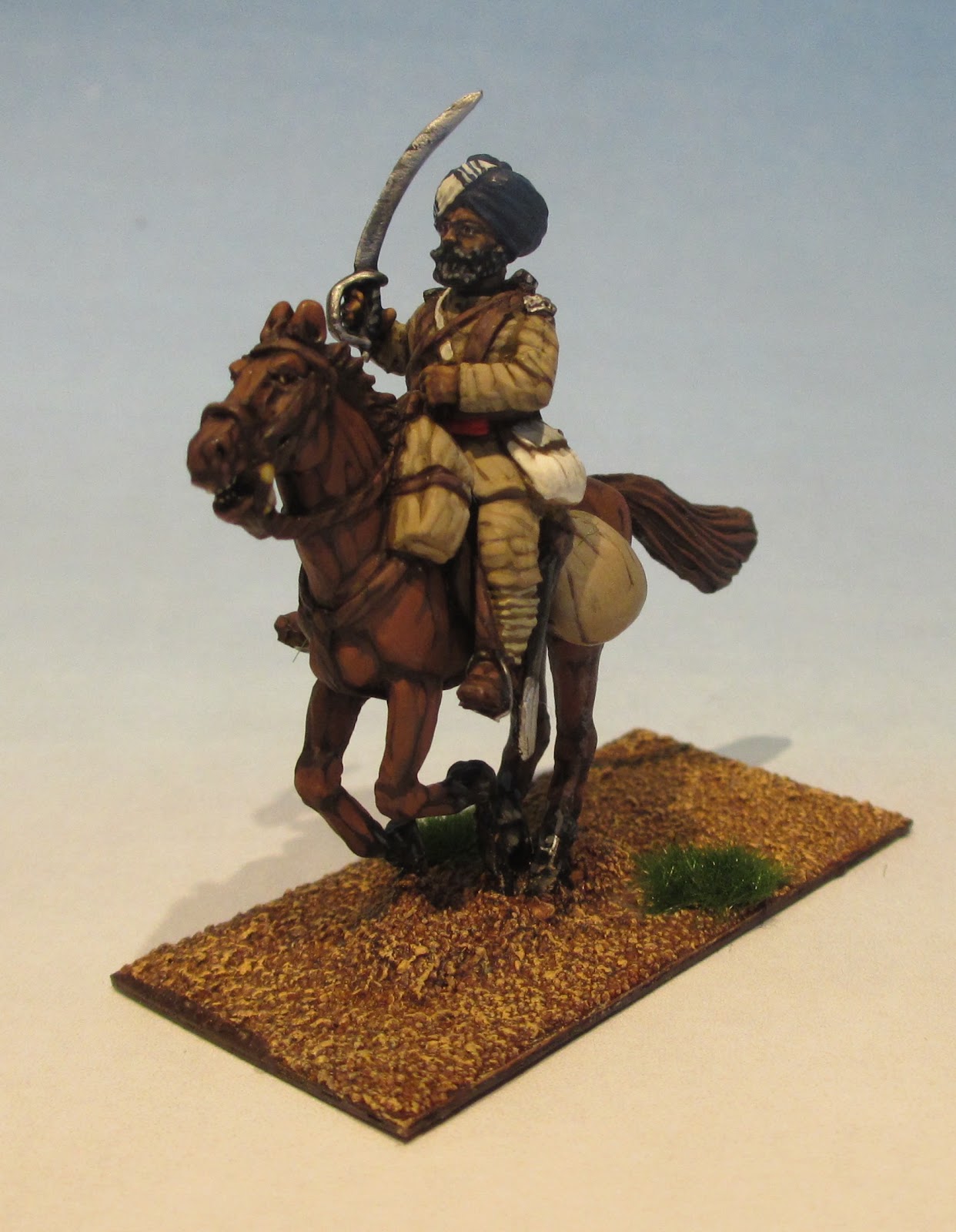 |
| Sowar |
 |
| Sowars |
Queen's Own Corps of Guides, Punjab Frontier Force
The Corps of Guides was raised in Peshawar by Lieutenant Harry Lumsden in December 1846, comprising one troop of cavalry and two companies of infantry, about 300 men in total.
 |
| Harry Lumsden |

The Corps of Guides was part of the Frontier Force brigade and it engaged in regular action along the North-West Frontier becoming an elite unit. The Guides was the first unit in the Indian or British Armies to dress in khaki.
The designations of the Corps of Guides was:
- The Corps of Guides (1846)
- The Corps of Guides, Punjab Irregular Force (1857)
- Corps of Guides, Punjab Frontier Force (1865)
- Queen's Own Corps of Guides, Punjab Frontier Force (1876)
- Queen's Own Corps of Guides (1901)
On the 3rd September 1879, without warning, Afghan soldiers attacked the British Commissioner's Residency in Kabul and were joined by the civilian population. 4 British personnel and 69 Indian troops faced thousands of Afghan soldiers and civilians. The Indian troops were 21 Guides Cavalry and 48 Guides Infantry under Lieutenant Walter Richard Pollock Hamilton. The British Envoy, Sir Pierre Louis Napoleon Cavagnari, KCB, C.S.I. was killed in the attack.
The Guides fought desperately, charging out of the Residency to bayonet the crews of artillery brought against them. During one of these attacks Lieutenant Hamilton was killed. The Residency was set on fire and the buidlings started to collapse.
The remaining Guides were commanded by Jemadar Jewand Singh (Guides Cavalry). The Guides rejected Afghan offers to surrender and after 12 hours of fighting the few remaining men fixed bayonets and charged to their deaths. Over 600 Afghan were killed in the action. Lieutenant Hamilton was awarded the Victoria Cross posthumously.
 |
| British officers of the Guides. Lieutenant Walter Hamilton VC stands on the right. |
My unit of Foot Guides uses Foundry figures. They have been painted based largely upon a print by Richard Simkin.
+-+Richard+Simkin.jpg) |
| Corps of Guides (Infantry & Cavalry) - Richard Simkin |
 |
| Queen's Own Corps of Guides, Punjab Frontier Force |

 |
| Guides infantry in their distinctive poshteens |
 |
| Jemadar |

15th (Ludhiana) Regiment of Bengal Native Infantry
The 15th (Ludhiana) Sikhs trace their origins to 1846, when they were known as the Regiment of Ludhiana. In 1861 they became the 15th Bengal Native Infantry and in 1864 the 15th (Ludhiana) Regiment of Bengal Native Infantry. In 1885 they became the 15th Regiment of Bengal Native Infantry (Ludhiana Sikhs).
.jpg) |
| British and Indian Officers of the 15th Bengal Native Infantry (Ludhiana Sikhs) 1885 |
The 15th Sikhs took an active part in the Second Anglo-Afghan War under the command of Lt. Colonel G. R. Hennessy. The Regiment joined General Stewart's invasion force on 24th October 1878 at Multan. At Sukkur the regiment was split into half-battalions, with one proceeding to Kandahar and Kelat-i-Ghilzai, and the other escorting a large convoy to Kandahar - the regiment was reunited at Kandahar in February 1879, where it garrisoned the citadel.
 |
| 15th (Ludhiana) Regiment of Bengal Native Infantry |
At the end of March 1880 the Sikhs marched through the valley of Khushk-i-Nakhud, and it joined Stewart's column on its way to Kabul at Karez-i-Oba. Four days later they saw action serving in Brigadier General R Barter's 1st Infantry Brigade of 1st Division at Ahmed Khel, and then again at Arzu on 23rd April. Operations in and around the Logar Valley included fighting at Jabar Kila in May.

After marching with Roberts' column to Kandahar in August, the 15th Sikhs were heavily involved in fighting Ghazis during the reconnaisance of Ayub Khan's position, and it was engaged again on the following day at the Battle of Kandahar, on 1st September 1880, serving in the 3rd Infantry Division under Major General Sir Charles Metcalfe McGregor.


My Ludhiana Sikhs wear the "transitional" uniforms of the Second Anglo-Afghan War, part khaki, part full dress. The figures are Perry Sudan Campaign Sikhs. In Afghanistan they still wore their traditional striped turban. They wore all-khaki uniforms in the Sudan, including khaki turbans.

In the Sudan Campaign the 15th Sikhs fought in the Battle of Tofrek, March 1885 and the Battle of Tamai in December 1888.
Subscribe to:
Comments (Atom)