Saturday, June 23, 2012

Queen's Own Corps of Guides, Punjab Frontier Force: Cavalry

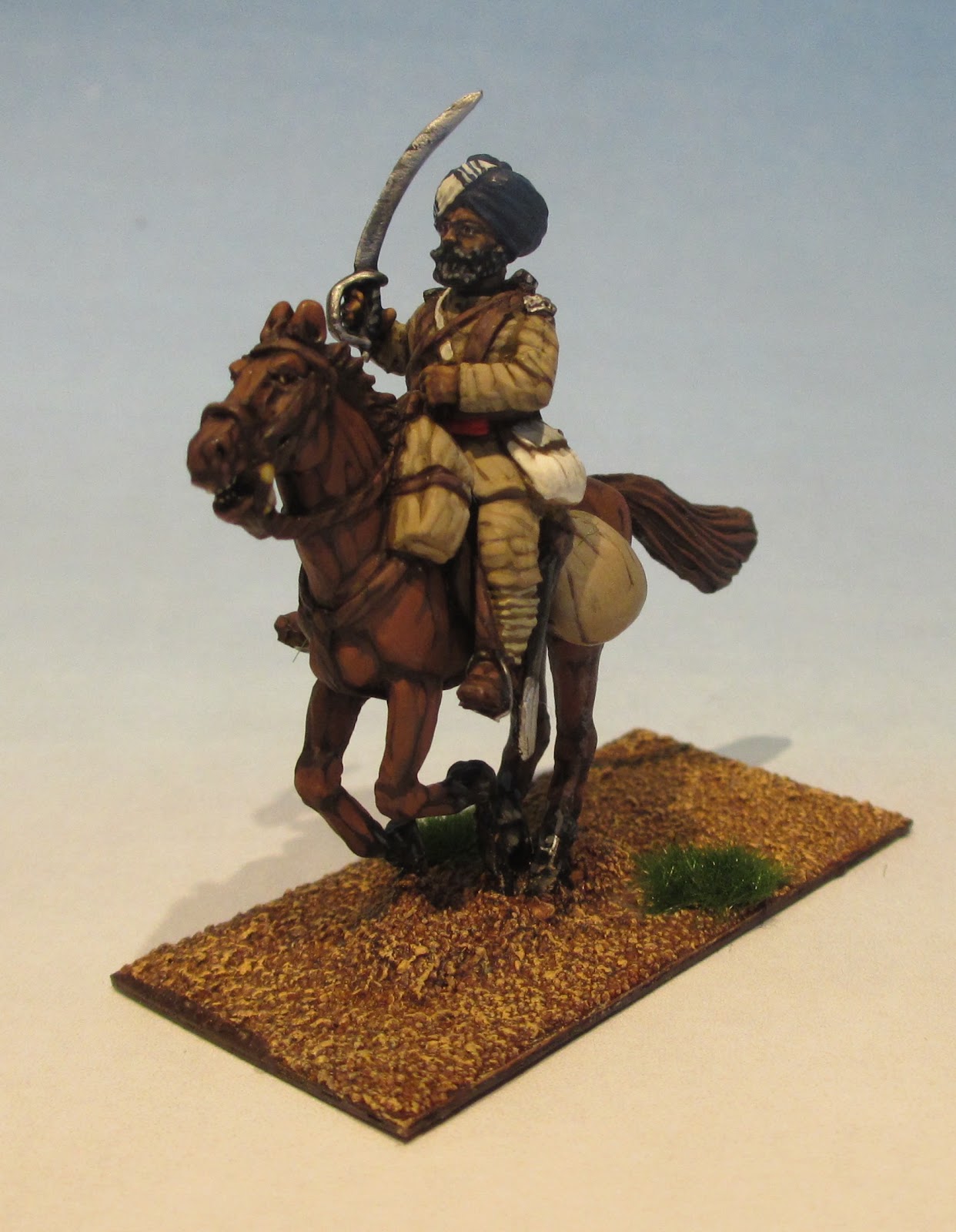
For the Mounted troops of the Queen's Guides, I used Perry Sudan Campaign figures, substituting swords for lances for the troopers. The Guides officer's silk pugree is more elaborate than most Imperial officers.

Queen's Own Corps of Guides, Punjab Frontier Force: Cavalry

Lieutenant Walter Hamilton, Queen's Own Corps of Guides

Lieutenant Walter Hamilton, Queen's Own Corps of Guides

Lieutenant Walter Hamilton, Queen's Own Corps of Guides


Jemadar Jewand Singh

Sowar

Sowar

Sowars

Queen's Own Corps of Guides, Punjab Frontier Force


The Corps of Guides was raised in Peshawar by Lieutenant Harry Lumsden in December 1846, comprising one troop of cavalry and two companies of infantry, about 300 men in total.


Harry Lumsden 

The Corps of Guides was part of the Frontier Force brigade and it engaged in regular action along the North-West Frontier becoming an elite unit. The Guides was the first unit in the Indian or British Armies to dress in khaki. 
The designations of the Corps of Guides was:
  • The Corps of Guides (1846)
  • The Corps of Guides, Punjab Irregular Force (1857)
  • Corps of Guides, Punjab Frontier Force (1865)
  • Queen's Own Corps of Guides, Punjab Frontier Force (1876)
  • Queen's Own Corps of Guides (1901)


On the 3rd September 1879, without warning, Afghan soldiers attacked the British Commissioner's Residency in Kabul and were joined by the civilian population. 4 British personnel and 69 Indian troops faced thousands of Afghan soldiers and civilians. The Indian troops were 21 Guides Cavalry and 48 Guides Infantry under Lieutenant Walter Richard Pollock Hamilton. The British Envoy, Sir Pierre Louis Napoleon Cavagnari, KCB, C.S.I. was killed in the attack.

The Guides fought desperately, charging out of the Residency to bayonet the crews of artillery brought against them. During one of these attacks Lieutenant Hamilton was killed. The Residency was set on fire and the buidlings started to collapse. 

The remaining Guides were commanded by Jemadar Jewand Singh (Guides Cavalry). The Guides rejected Afghan offers to surrender and after 12 hours of fighting the few remaining men fixed bayonets and charged to their deaths. Over 600 Afghan were killed in the action. Lieutenant Hamilton was awarded the Victoria Cross posthumously.


British officers of the Guides. Lieutenant Walter Hamilton VC stands on the right. 

My unit of Foot Guides uses Foundry figures. They have been painted based largely upon a print by Richard Simkin.


Corps of Guides (Infantry & Cavalry) - Richard Simkin


Queen's Own Corps of Guides, Punjab Frontier Force

Guides infantry in their distinctive poshteens

Jemadar


15th (Ludhiana) Regiment of Bengal Native Infantry


The 15th (Ludhiana) Sikhs trace their origins to 1846, when they were known as the Regiment of Ludhiana. In 1861 they became the 15th Bengal Native Infantry and in 1864 the 15th (Ludhiana) Regiment of Bengal Native Infantry. In 1885 they became the 15th Regiment of Bengal Native Infantry (Ludhiana Sikhs).

British and Indian Officers of the 15th Bengal Native Infantry (Ludhiana Sikhs) 1885

The 15th Sikhs took an active part in the Second Anglo-Afghan War under the command of Lt. Colonel G. R. Hennessy. The Regiment joined General Stewart's invasion force on 24th October 1878 at Multan. At Sukkur the regiment was split into half-battalions, with one proceeding to Kandahar and Kelat-i-Ghilzai, and the other escorting a large convoy to Kandahar - the regiment was reunited at Kandahar in February 1879, where it garrisoned the citadel. 


15th (Ludhiana) Regiment of Bengal Native Infantry

At the end of March 1880 the Sikhs marched through the valley of Khushk-i-Nakhud, and it joined Stewart's column on its way to Kabul at Karez-i-Oba. Four days later they saw action serving in Brigadier General R Barter's 1st Infantry Brigade of 1st Division at Ahmed Khel, and then again at Arzu on 23rd April. Operations in and around the Logar Valley included fighting at Jabar Kila in May. 


After marching with Roberts' column to Kandahar in August, the 15th Sikhs were heavily involved in fighting Ghazis during the reconnaisance of Ayub Khan's position, and it was engaged again on the following day at the Battle of Kandahar, on 1st September 1880, serving in the 3rd Infantry Division under Major General Sir Charles Metcalfe McGregor.


My Ludhiana Sikhs wear the "transitional" uniforms of the Second Anglo-Afghan War, part khaki, part full dress. The figures are Perry Sudan Campaign Sikhs. In Afghanistan they still wore their traditional striped turban. They wore all-khaki uniforms in the Sudan, including khaki turbans.


In the Sudan Campaign the 15th Sikhs fought in the Battle of Tofrek, March 1885 and the Battle of Tamai in December 1888.


Monday, April 16, 2012

The Blog is Back!


I'm happy to report that, with the help off my son John and friend Yanni Mavromichalis, I have been able to restore my original Horse-and-Musket Blog and Website with all of the old galleries. The wonders of hidden files in Mac Lion OS!


http://www.horse-and-musket.com/horse-and-musket/Home_Page/Home_Page.html

Friday, April 13, 2012

5th (Royal Irish) Lancers


The 5th (Royal Irish) Lancers can trace it's origins back to 1689 when a dragoon regiment known as "Wynne's Regiment of Enniskillen Dragoons" was organized.

A small detachment was sent to serve with the Heavy Camel Corps during the Egyptian Campaign, where they suffered some casualties at Abu Klea. The Regiment provided two squadrons of cavalry for the Gordon Relief Force, along with the 20th hussars and 9th Bengal Cavalry. They saw action at Suakin on the Red Sea, Hasheen and Tamai. During the fighting at Suakin, they charged with lances and routed the opposing Dervishes. The regiment was awarded the battle honour "Suakin 1885" and the two squadrons were awarded the Egyptian Medal with clasps "Suakin 1885" and "Toftek".


The Royal Irish Lancers at Suakin, 20th March, 1885


I commissioned one troop of the 5th for my Colonial war-games, using Perry figures to which I added bamboo lances from Foundry and GMB lance pennants. They may have to serve in my 2nd Afghan War until I commission the 9th (Queen's Own Royal) Lancers. The Regiment was awarded the Battle Honours: Charasiah, Kabul 1879, Kandahar 1880 and Afghanistan 1878-1880.


Wednesday, April 11, 2012

45th (Rattray's Sikh) Native Regiment of Infantry


Origins
The 45th Rattray's Sikhs originated as the 1st Bengal Military Police Battalion. Raised in April 1856, at Lahore by Captain Thomas Rattray, the unit originally consisted of a troop of 100 cavalry and 500 infantry,  of which 50% were Sikhs and 50% Dogras, Rajputs and Muslims from the Punjab and NW Frontier. In 1864 the infantry section was redesignated Bengal Native Infantry as the '45th (Rattray's Sikh) Native Regiment of Infantry'.


45th platoon on the march, regimental Bhishti in tow


Afghanistan 1879
In March 1879 a detachment of the 45th under Lt. Barclay was providing a protective escort for Capt. Leach, Royal Engineers, who was carrying out a survey when they were attacked on a hill by large numbers of Shinwari tribesmen. The party began an orderly withdrawal, but Barclay was hit. Some of the Sikhs started to carry him downhill while Leach organised a skirmishing line to cover the retreat. As the tribesmen closed in for a rush, Leach called the troops together and led them in a sudden bayonet charge. After a fierce fight he was able to continue the withdrawal, although the outnumbered Sikhs had to charge twice more before Barclay could be got away. Leach was awarded the Victoria Cross.

And here they are in real life captured in this excellent photo (public domain) from Wikipedea.

45th Rattray's Sikhs with prisoners from the Second Anglo-Afghan War 


Tuesday, April 10, 2012

The Sword and the Flame

After a long break, and much time trying to get my old Blog working, I'm going to focus my efforts on this new blog. Eventually I will try to load the old galleries.

Meanwhile, what's new?

Well the Second Afghan War for one. I'm going to take the liberty of directing the reader to Jeff Lower's article in his own blog which tells the tale of the building and gaming of our group's first Colonial units and skirmish game.

http://squadpainter.blogspot.com/

On the British/Indian side was one tough platoon of Sikh's, painted for me by Carl Robson. The native Pathan tribesmen were painted by Jeff, Will and myself over two Saturday's recently.

We all feel that the the venerable Sword and the Flame rules are a great way of gaming this period. More units of British and Indian troops will arrive shortly.


Perry's Sudan War Sikh's painted as 45th (Rattray's) Sikhs


Rattray's victorious!

I would like to thank Ethan "Mad Guru" Reiff for not only providing the original inspiration by putting on "Maiwand Day" at the Muzeo last year, but also providing numerous helpful pieces of advise to get us from a very minimal understanding of the period, to being really hooked!